Note: I’ll be retiring in July 2026, after 40 years of teaching English as a foreign language to deaf and hard-of-hearing students. (Actually, after 41 years, but my first year didn’t count…)
So, why exactly did it take me more than 40 years to have a weekly joke/pun bulletin board displayed in class?
The answer is actually quite simple.
Overthinking it.
(I have a strong urge to say “I over-thunk it” but I have no idea where that originated…)
I’ve always toyed with the idea. But it seemed daunting, as in my learning center for deaf and hard-of-hearing teens, I teach every possible level. So:
What level should the jokes be suitable for?
Do I need several joke boards for different levels?
Will the weak students be offended, and the advanced students bored?
How do I keep track of who has seen the joke and who hasn’t before replacing it with a new one? Remember, my students don’t come to me as “a class”, every student has their own individual schedule…
Should it be cartoons with captions instead of just words, to fit in with my emphasis on the visual aspect of everything?
Where will I find the jokes? Will I have enough?
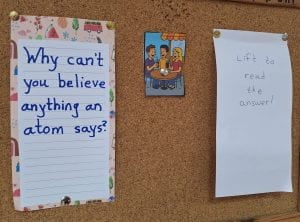
Answer: ” Because atoms make up everything!”
AND AND AND AND…
The two factors that in the past always made me put aside the “joke board” idea:
It seemed to be too much work. As it is, I have to keep track of so much and prepare everything at different levels.
I’m not a funny person. People say all sorts of things about me, but being funny is not one of them. Not at all. I did not trust myself to choose suitable jokes for teens…
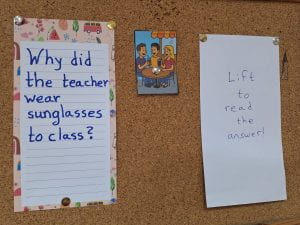
Answer: Because she has bad blood!
Then one day…
I found myself staring at this joke I encountered on Facebook related to the singer Taylor Swift, thinking, ” Vampires, Taylor Swift, blood…maybe the students would like this?”
Retiring is about gradually letting go, right?
Let’s just try posting the joke and see what happens.
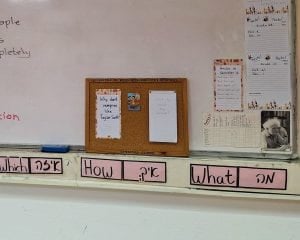
The joke board is leaning on the whiteboard, a bit to the side.
Not a single student noticed this new addition to the classroom decor, leaning on the whiteboard, despite its fairly prominent place!
So, on the following days, I pointed out the joke to students as they walked in, though sometimes I forgot to do so.
I didn’t track who had seen it or who hadn’t.
I let the stronger students explain the joke to the weaker students. Some only responded with their feelings about Taylor Swift, ignoring the joke, while others were amused.
The first week wasn’t very encouraging, but I keep posting the jokes /puns weekly. Now, several weeks later, some of the students check the board regularly; they comment on how good /bad the joke is, while others will only look if I physically lay the board on their desk first. Something I don’t always remember to do.
I had a brief moment of stress when I almost went down the rabbit hole of investing time in what to do with the “used” jokes I was taking off the board (thoughts such as “should I keep them in plastic coverings to be reused in the future and make a little booklet…” aargh), but I decided to just place the used jokes in a box.
I don’t have to plan for posterity anymore.
I’m retiring.
I’m just having fun laughing with the students or discussing the jokes with them!
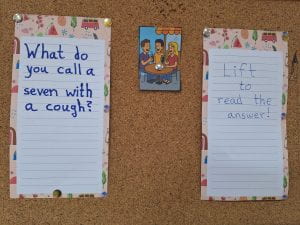
Answer: A sick seven!
*** Some notes about this joke, currently hanging in my classroom:
Some students thought this joke was really clever. Two students criticized me for bringing this “thing from 2025 into 2026. We’re done with it”!
The two profoundly deaf students (most of the students function as hard-of-hearing students when they use their cochlear implants or hearing aids) didn’t get it. “sick” and “six” are two visually distinct words for them…
For once, I’ll start with the bottom line – I REALLY ENJOYED READING THIS BOOK!
I couldn’t put it down…
I have a soft soft for books written as an exchange of letters. I love the way I gradually gather information about the characters and the plot begins to form and make itself clear. Each letter promises a fresh detail or meaning to uncover. This book has a main character, Sybil, who corresponds with many others. The different letters from varied people let you think about the events in question from different perspectives without being confusing.
I can relate to the fact that in the act of writing one has to consider and clarify thoughts and feelings. Sybil is in her mid seventies and we learn about her life both present and past.
A different conversation… Naomi Epstein’s Photos
“The Correspondent” caught my interest on page one. It is simply so well written that in my mind I have placed it on a virtual shelf beside my favorite books written in the format of letters, namely “84 Charing Cross Road” by Helene Hanff, “The Color Purple” by Alice Walker and “Address Unknown” by Katherine Taylor.
Note: I just went back and read my post from 2020 about the book “Meet Me at the Museum” by Youngson. Not only should I have placed it besides the above mentioned books on my virtual bookshelf, the post reminded me that I should be saying an “epistolary novel” instead of “books witten in the format of letters”. But I never liked the sound of the word “epistolary”…
Tread carefully when you write… Naomi Epstein’s Photos
The book comes with a surprising “fringe benefit” – it’s full of book reccommendations! Not only do some of the characters reccommend books to each other, but the protagonist Sybil writes to the authors who wrote books that moved her. I’ve read a few of the books mentioned and made notes for myself to look for some of the others. The library had one of the books mentioned available immediatly, so I’m already entering a totally different world. More on that to come!
Note: I’ll be retiring in July 2026, after 40 years of teaching English as a foreign language to deaf and hard-of-hearing students. (Actually, after 41 years, but my first year didn’t count…)
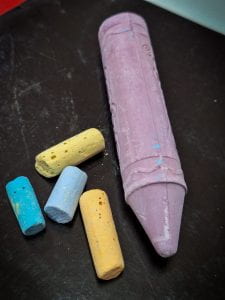
Chalk.
Glorious bright colors on the board.
Vivid colors on the board and all over my hands…
I pressed too hard, and they snapped. Since I always press hard when I write (I’m unable to use a mechanical pencil!), bits of chalk were my writing tools.
Clap your hands – chalk dust off.
Erase the board – cough in a cloud of dust, which would get bigger as the lesson progressed and the eraser absorbed more and more chalk dust.
I never tried to master the art of throwing chalk at a daydreaming student, despite having had a math teacher back in high school who excelled at it. His aim was impeccable! The students actually respected him more after each flying piece of chalk! Despite this fine example, I was too aware of reality to attempt it. Not only could I not rely on my motor skills to get the chalk to land at its destination, but chalk-throwing was absolutely not a behavior I wanted to model for my deaf and hard-of-hearing students!
Move over, chalk! Naomi Epstein’s Photos
One day, I came to class and discovered that the school had installed a very small, square whiteboard in my classroom, while leaving the long, rectangular greenboard on the other wall. We had to turn all the desks and chairs around to face the newcomer.
That turned out to be a win-win combo, which I enjoyed for about fifteen years until I had to move classrooms.
The green board became a makeshift bulletin board. I used different colors to post the grammar structures we were learning and new vocabulary items. I didn’t suffer from the chalk dust because the material would remain up for at least two weeks.
Meanwhile, what a treat those markers seemed!
I could just toss them in my schoolbag, without needing a special protective box like I had to have for the chalk.
The markers didn’t snap in half, and I no longer coughed when erasing the board, which are serious points in their favor.
Was it a blackboard or a greenboard when I began teaching? I can’t recall…
However…
Markers can be difficult to erase, too, especially as whiteboards age.
And you simply cannot place a marker on its side and roll it across the board to create a bright, thick border around your message to the students.
Farewell, chalk and whiteboard markers! I shall do well without you both!
Time left until the school year ends… Naomi’s photos
It may only be mid-May, but many of my 10th-grade hard-of-hearing and deaf students are as restless as if the summer holidays were beginning next week! Those who aren’t absent, that is…
So, I brought out this old activity related to texting abbreviations , using one of my favorite animated short videos “The Present”.
Old… Naomi’s photos
Old.
Yes, old, about seven years old.
I was concerned that perhaps some of the abbreviations wouldn’t be relevant nowadays but that just added interest to the activity. The students commented on which ones they thought were passe and which were still in use. Some were suprised to discover which words a familiar abbreviation actually represented – LOL is Laughing Out Loud and not “can’t stop laughing”!
CUS (See you soon!) – surprised some of my hard of hearing students, since the abbreviation is so related to sound.
Communication! Naomi’s photos
The students begin with the top part of the worksheet, before watching the lovely (absolutely lovely!) short video. On this part they are asked to match abbreviations to their meanings using a word bank.
After watching, the students match screen shots from the video with short senteces, which they must write out in full, without abbreviations.
Find the activity below.
Enjoy!
***NOTE: I’m leaving the link to the online version. HOWEVER, it is NOT a self-check activity, so you may prefer to download the PDF.
So, what better way to escape reality and dive into a fantasy book? Makes sense, doesn’t it?
Well…
I began with a book that got good reviews “Empire of Wild” by Cherie Dimaline.
I found the book to be engrossing from page one and very well written. The combination of reality and fantasy is clever. But I had to stop reading at a fairly early stage. Once I realized that the plot was basically about a woman whose husband was kidnapped by an evil mythical/fantastical shape-shifting creature and felt the depths of the heroine’s misery, I was unable to continue reading. While I believe she rescues him in the end, I simply can’t deal with such a topic now.
A second life? Naomi’s photos
The next book I took up was “Three Parts Dead” by Max Gladstone. This is a fast-paced book, clever and often funny, with surprises along the way. Think of a courtroom drama murder-mystery (Grisham style) set in a fantasy world with the courageous young female lawyer saving the day against all odds, told in a style that sometimes reminded me of the beloved Terry Pratchett.
I enjoyed the book, despite having a slight crisis when realizing the book was a “ whodunnit”. As a rule, I do not like the genre, but I’m glad I read this book!
As I was returning “Three Parts Dead” my Libby app pinged – a book I had reserved a few months ago was now ready for lending:
Mansplaining… Naomi’s Photos
“This is How You Lose The Time War“ by Amal El-Mohtar and Max Gladstone.
While I am truly full of compliments for this book, I stopped reading sixty percent through ( yes, I’ve become quite difficult!).
The book is written in a format of letters, a style I enjoy. The two authors actually wrote their characters’ letters separately and surprised each other with details (they had agreed on the plotline and other main things) which must have added to the sense of authentic enthusiasm and emotion. The writing is excellent and the whole setting and the points the two authors convey are powerful.
However…
Two things bothered me the more I read. For one, I felt too old for this tale of the stirrings of first love and even “coming of age” (though the main characters are adults). I know you are never supposed to be too old for such a thing but honestly, there that feeling was.
In addition, the fact that people’s lives and deaths are being controlled like pawns in a war between forces that we cannot influence is depressing. The book is NOT in favor of waging war, but by the time I got to sixty percent of the book I couldn’t go on the journey with the characters to get to the more optimistic parts.
It’s a good book – give it a try! You might love it!
I finished reading this book three weeks ago and I’m still thinking about it.
For me, that’s an excellent sign.
I found “Happiness” to be a book that was very readable, yet had the sort of combination I like:
a plot that moves forward, interesting characters (there’s some romance too), and historical connections
There’s so much else going on too. Some of which was apparent to me as I read, while other connections I realized after I had completed it.
One way of protecting nature Naomi’s Photos
I don’t want to say much about the plot – I knew nothing about the book except that it was warmly recommended, and I’m glad for it. I’d be delighted to correspond about it after you’ve read it!
Most of the story takes place in London, some In New England, while Sierra Leon and other locations come up as well.
While the locations are interesting, the book is about people, animals and people, people and people, trauma and resilience, hope, and, of course,
“I was prepared to dislike Max Kelada even before I knew him”.
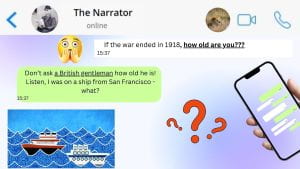
W. Somerset Maugham’s opening sentence of the story “Mr. Know All’ is clear.
However, in the early years, when I still didn’t have a good pre-reading slideshow, my students would run into trouble understanding the story by the second sentence:
“The war had just finished and the passenger traffic in the ocean-going liners was heavy”.
The war in question is World War 1.
You may think that it doesn’t really matter that my Deaf and hard-of-hearing high school students haven’t a clue as to when that war ended (some are a bit surprised that there was a WW1 even though the numbering should have been a clue…) but it actually matters a great deal.
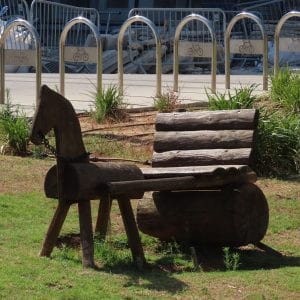
For starters, if I don’t emphasize the time frame my students cannot fathom why the characters are spending two weeks on a ship instead of hopping on a plane, spending their time ignoring the other passengers.
There would be no drama without the journey on the ship.
From the new video lessonNot a ship. Let’s imagine a slow horse and buggy, ok? Naomi’s Photos
Then my students get confused by the whole issue of nationalities.
“… I should have looked upon it with less dismay if my fellow passenger’s name had been Smith or Brown.”
Those surnames do not indicate any nationality at all to my students…
There is so much background knowledge that comes up in the first paragraph of the story!
The narrator was traveling from San Francisco to Yokohama
My students assume the narrator was American (once we ensure everyone knows where these cities are located…) because who else travels from San Francisco?
After my students have already jumped to conclusions it’s much harder for them to internalize the information about the British Empire and who is or isn’t a real “British Gentleman”.
At least someone is sure of himself! Naomi’s Photos
In short, a pre-reading task to set the stage was crucial. The old slideshow was helpful, but the new video version is much more attractive to teenagers.
In this Visual Lesson (Visual Lesson = See, Read & Listen), the students get to “chat” with the narrator of the story “Mr. Know All”. As in every Visual Lesson, you will find the use of visuals, alongside texts to read and listen to.
I’m so grateful to the amazing Dorit Renov, who brought the video to life by narrating the dialogue while using different voices for the various characters that appear in the video.
3 distractors on a multiple choice question Naomi’s Photos
Remember that story about the hare and the tortoise?
I usually dislike that story in the context of an EFL classroom, since it often doesn’t reflect reality.
However, when it comes to taking reading comprehension exams, particularly those including multiple-choice type questions, the students who behave like tortoises (“slow and steady) generally avoid the “Look-Alike” traps, even if they are weaker students than some of the “hares”.
Who are the “hares” that so blithely choose an answer to a multiple-choice question just because it includes words that appear in the relevant part of the text?
smart, over-confident students who are fooled by how easily they understand the text and barely read the questions
students whose top priority is their social status – leaving the exam room as quickly as possible, perhaps coughing loudly as they exit so that everyone will see…
students who think they have mastered all the tricks to taking reading comprehension exams without actually reading the text
I’m sure you know students who behave in this manner!
Who, me? Naomi’s Photos
On my journey to review decades’ worth of materials that have served me well, and then renew them by turning them into Visual Lessons ( = See/ Listen / Read) on my YouTube channel, I found that I could not link my beloved worksheet to the latest video lesson: The “Look-Alike” Trap
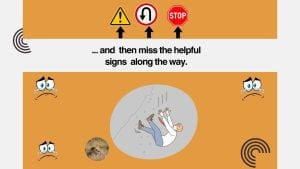
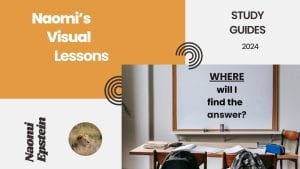
The worksheet is simply not designed for self-study, and cannot be self-checked. That format worked well for the Visual Lesson on “Where will the Answer Be”
In short – while the students will find the video lesson designed for clarity and self-study, they need a teacher to benefit from the worksheet. Which is why I am offering it to the readers of this blog.
On the worksheet, the teacher and the students examine eight sentences, which I have modified from actual national exams (I had to modify the sentences to make them clear when being read out of context) and corresponding incorrect answers chosen by unknown students who had forgotten about the “look-alike traps”. The teacher supplies any glosses for vocabulary items, as needed. The students lead the activity.
I have found that almost all of my students were able to explain why the distractor chosen was incorrect, as they were focused on the challenge of outsmarting whoever set the traps. They felt empowered!
**** That’s why I used the image of a trap – the students respond to that!
Naturally, many of my students claim, while doing the worksheet they would never fall into such a trap….
Eh… Hmm…
Here is the Visual Lesson:
Here is the worksheet I used. The downloadable document contains two versions – one with the “critical” words underlined, and the other with no hints whatsoever. I used the version without any words underlined.
***Remember – this is not a worksheet for self-study. It is the discussion that matters!
A lesson that includes words to read, an audio narration of the written words appearing in the video, and LOTS of visuals that help clarify what is being explained.
See/ Listen / Read
Designed for clarity!
Note: Some lessons include a link to a practice worksheet after the student watches the lesson.
Hmmm, I wrote “lessons” in the plural form.
I have several lessons in preparation, and decades (quite literally!) of materials waiting their turn to be upgraded, but currently there is one Visual Lesson online: